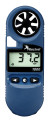
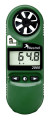
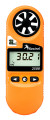
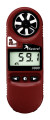
View live wind data from our wind systems at Lymington, Hurst Castle, Highcliffe and Portland Harbour (The 2012 Olympic sailing venue)
coming soon...
The mass of water vapour in a unit volume of moist air of a given temperature and pressure. (unit g/m3)
The mass of air per unit volume. It is a function of temperature, humidity, and pressure.
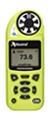
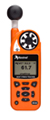
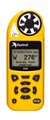
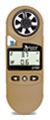
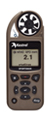
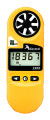
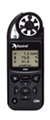
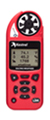
The Kestrel 4250 racing weather tracker measures air density to assist those in motor sport racing involved with jet engine tuning. It also calculates the Relative Air Density (RAD).
The atmospheric pressure, temperature and humidity all affect the density of the air. On a hot day, at high altitude or on a moist day, the air is less dense. A reduction in air density reduces the amount of oxygen available for combustion and therefore reduces the engine horsepower and torque possible. For tweaking the fuel/air mixture, the air density is the most important consideration.
The distance above sea level. The Kestrel Weather Meters calculate altitude based on the measured station pressure and the input barometric pressure - or "reference pressure".
An instrument for measuring wind speed or air flow.
An instrument for measuring atmospheric pressure.
Temperature scale with the ice point of water as 0 and the boiling point as 100 at 1 standard atmosphere pressure. The degree Celsius is equal in magnitude to the Kelvin. The Celsius scale is the same as the centigrade scale. The temperature in Celsius = the temperature in Kelvin - 273.15
Delta T is the spread between the wet bulb temperature and the dry bulb temperature (in degrees C).
Delta T measurement is used primarily by agricultural professionals involved in crop spraying. Delta T offers a quick guide to determining acceptable spraying conditions. For example, it is not recommended to apply pesticides when Delta T is above 10 - a range of 2 to 8 is ideal.
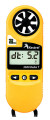
A Kestrel 3500 delta T pocket weather meter calculates the delta T for you - quickly and accurately with barometric pressure correction in its wet bulb temperature calculation.
Density altitude is one way to express the air density.
Density altitude is the altitude at which the density of the Standard Atmosphere is the same as the density of the air being measured. So to calculate density altitude, it is necessary to calculate the actual density of the air, and then find the altitude at which that same air density occurs in the Standard Atmosphere.
The concept of density altitude is commonly used to help express the effects of aircraft performance, however, the underlying property of interest is actually the air density. It is often used by individuals who tune high performance internal combustion engines, such as race car engines.
Air density is perhaps the single most important factor affecting airplane performance. It has a direct bearing on:
As a result of a density altitude that is higher than the actual physical altitude, the following effects are observed:
Race car drivers and pit crews also monitor the density altitude because the car's high performance engine will perform differently depending on the density altitude. The Kestrel 4250 racing weather tracker is an ideal instrument to monitor this and other performance-affecting weather conditions.
Some long range shooters also consider the density altitude, as it can influence the bullet's performance.
Temperature scale with the ice point as 32 and the steam point as 212. Thus the temperature in Fahrenheit = 32 +1.8 x the temperature in Celsius.
A scale F0 to F6 that indicates the amount of damage a tornado causes.
Unit of pressure used in meteorology. One hectopascal equals 100 Pascals (1 hPa = 100 Pa)
An instrument for measuring humidity.
Unit of thermodynamic temperature. 1/273.16 of the thermodynamic temperature of the triple point of water.
Old unit of pressure, now replaced by the hectopascal. (1 mbar = 1 hPa)
SI unit of pressure defined as the pressure which applied on a plane area of one square metre, exerts perpendicularly to this surface a total force of one Newton.
The ratio, expressed as a percentage, of measured air density to standard air density. Standard air density uses standard (fixed) values for temperature, humidity and pressure.
RAD increases with an increase in barometric pressure (e.g., going to a lower elevation) and/or a decrease in ambient temperature. Conversely, RAD decreases with a decrease in barometric pressure and/or an increase in temperature. At standard temperature and pressure the RAD will be 100 percent.
If a measurement of Relative Air Density takes into account the humidity it is known as the 'corrected RAD' .
RAD is important to tuners setting up the correct jet size for bike and motor racing. By knowing the conditions and changing the jets accordingly, it is possible to achieve the maximum possible horsepower for the actual weather conditions experienced.
The Kestrel 4250 racing weather tracker will provide you with an easy and accurate measurement of Relative Air Density.
The ratio, expressed as a percentage, of the actual vapour pressure to the saturation vapour pressure.
Mass of water vapour per unit mass of humid air. (unit g/kg)
A semiconductor device of which the electrical resistance changes with temperature.
The virtual temperature is the temperature of dry air that would have the same density and pressure as the moist air.
Water Grains is a measure of how much moisture (water) in grains is in a pound (lb) of air.
Water grains is primarily used by those involved in motor racing. Since water grains is an absolute measurement of moisture, a racer can look at this value to determine if the engine will be more or less powerful in comparison to previous atmospheric conditions. For bracket and class racers, this helps determine the dial in or throttle stop timers. For professional drag racers, (or any type of drag racing where the first one to the finish line wins) it helps in determining adjustments to the clutch, fuel, ignition, chassis, etc., that may need to be made to compensate for the loss or gain in power. More water in the air equals less power, while less water in the air equals more power.
Racers find Water Grains more useful than Relative Humidity as its value does not change with temperature.
The Kestrel 4250 racing weather tracker measures water grains as well as other useful parameters for engine tuning, including air density, relative air density (RAD) and density altitude.
The temperature of the wet thermometer bulb in a wet and dry bulb hygrometer. The wet bulb is surrounded by wet fibres and evaporation of water from the fibres cools the wet bulb. The rate of evaporation depends on the relative humidity of the air.
The chilling effect of the wind can be represented by the lower temperature that would be required to produce the same chilling sensation for a person walking in calm conditions. This is known as the wind chill equivalent temperature and is an important indicator in assessing the comfort of personnel spending periods outdoors. It is not an indication that an unheated inanimate object will cool below the ambient air temperature.
The Kestrel's calculation of Wind Chill utilises the (US) NWS Wind Chill Temperature (WCT) Index, revised 2001, with wind speed adjusted by a factor of 1.5 to yield equivalent results for wind speed measured at 10m above ground.
For more information about wind chill see table
If you can't find the information you are after, please contact us and hopefully we can help.