Gill WindSonic 60 Anemometer
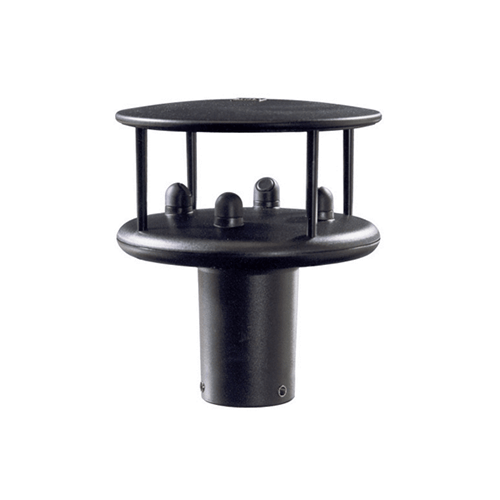
Starts atThe WindSonic wind speed and direction sensor range utilise proven ultrasonic technology from Gill Instruments. This 2-axis ultrasonic wind sensor has no moving parts and is maintenance-free and easy to install. The WindSonic is compatible with RPR’s SpaceLogger data loggers and the WeatherFile Communication Unit (WCU) delivering a complete end to end IoT connected wind speed and direction monitoring solution.
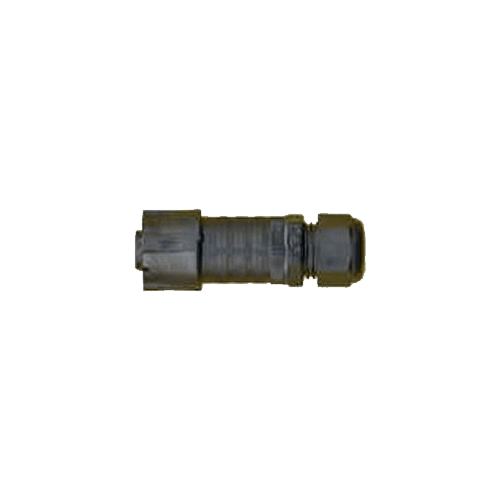
When purchasing the sensor by itself and not as part of a system or with a cable a WindSonic connector is included.
PLEASE NOTE: Sensor also available in white by request only.
Product Description
The WindSonic solid-state ultrasonic technology provides many advantages over conventional cup anemometers and vane sensors. Having no moving parts that can jam, break or wear out makes it the sensor of choice for harsh weather conditions and remote locations when you need to know you can just fit and leave without fear of failure or damage that occurs with traditional cup and vane sensors.
WindSonic sensors come in four variants and are suitable for a wide range of wind monitoring applications, including marine & offshore (ships, data buoys) and land based installations. With a corrosion free polycarbonate construction and no moving parts, this ultrasonic wind sensor eliminates the need for expensive on-site maintenance, particularly in remote locations where access is difficult.
WindSonic 60 sensor options depending on output requirements:
• WindSonic Option 1: Transmits using RS232 standard communication. Compatible with RPR’s SpaceLogger data loggers and the WeatherFile Communication Unit (WCU) for distances less than 20 metres and when the electrical environment is benign.
• WindSonic Option 2: Transmits using RS422/RS485/NMEA communication standards. Compatible with RPR’s SpaceLogger data loggers and the WeatherFile Communication Unit (WCU) for distances over 20 metres. For use where there may be heavy duty electrical equipment in operation in the vicinity.
• WindSonic Option 3: Transmits using RS232 or RS422/RS485/NMEA and analogue outputs, used when an analogue output is specifically required. Note if used with our WS-15A display output must be set to RS422/485. Analogue output type may be selected from 0-5V, 0-20mA or 4-20mA.
• WindSonic Option 4: SDI-12 output only.
Configuring the WindSonic Sensor:
WindSonic sensors can be configured using the free software provided to select the output rate and units of measurement that suit the application. WindSonic automatically transmits an anemometer status code with each output to indicate its operating status. This ensures accuracy and reliability.
To change the setting of a WindSonic sensor from the default factory settings, it is possible to communicate with the sensor direct from a PC using HyperTerminal (or similar terminal emulation package). Use the WindSonic/GMX D9 Serial Config Cable or the WindSonic/GMX USB Config Cable for easy connection to a PC and power supply.
Applications
• Remote wind monitoring stations
• Road & rail tunnels
• Building controls
• Environmental field sites
• Data buoys
• Ports & harbours
• Marine vessels
• UAV’s
• Mobile weather monitoring vehicles
• Small airports & helipads
• Coastal weather monitoring stations
• Yacht clubs
• Golf courses
• Tower crane operation
• Health and safety
• Educational
• Wind turbine, renewable energy
Additional information
| Attributes: | 0.60 m/s (216 km/h) wind speed, 0-360° wind direction, NMEA output, Corrosion free polycarbonate, Available in black or white, 0.5kg |
|---|---|
| Option | WindSonic 1 – RS232, WindSonic 2 – RS232/422/485, WindSonic 3 – RS232/422/485 + Analogue, WindSonic 4 – SDI-12 |
• Wind speed & direction sensor
• Compatible with SpaceLogger data loggers
• WeatherFile cloud solution ready
• Units of measure: m/s (default), knots, km/h, mph, ft/min, degrees
• Excellent accuracy: Speed ±2% @12m/s, Direction ±3° @12m/s
• Wide wind speed range: 0 to 60 m/s (116knots, 134 mph)
• True 0-360° operation with no dead band
• Wide operational temperature range: -35°C to +70°C
• Low start up speed (0.01 m/s)
• Fast start-up
• Lightweight
• Low power consumption
• No moving parts
• IP66 rated, robust, high strength construction
• Solid-state, no need for on-site calibration or maintenance
• Corrosion free exterior
• 4 sensor options depending on output
• 24 months warranty
• NMEA output
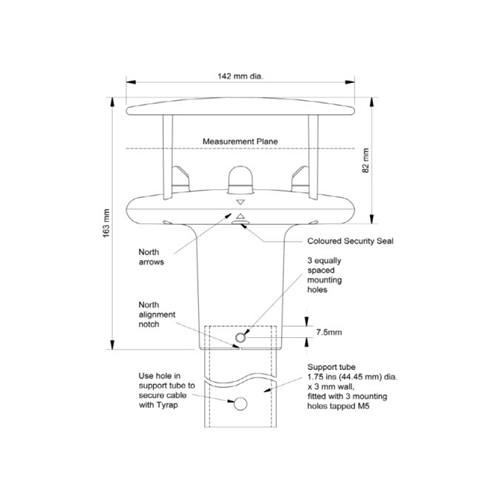
| Physical | Dimensions | 142mm diameter x 160mm | |
| Weight | 0.5 kg | ||
| Mounting | Pipe mounting 1.75 in (44.45mm) diameter | ||
| Material | LURAN UV stabilised black thermoplastic | ||
| Performance | Wind speed | Range | 0 to 60 m/s (116 knots, 134 mph) |
| Accuracy | ±2 % @ 12m/s | ||
| Resolution | 0.01 m/s | ||
| Threshold | 0.01 m/s (0.02 mph) | ||
| Response time | 0.25 sec | ||
| Wind direction | Range | 0 to 359° (no dead band) | |
| Accuracy | ±3° @12 m/s | ||
| Resolution | 1° | ||
| Response time | 0.25 sec | ||
| Outputs | WindSonic Option 1 | RS232 | |
| WindSonic Option 2 | RS232 RS422/RS485 NMEA 0183 |
||
| WindSonic Option 3 | RS232 RS422/RS485 Analogue 0-5V, 0-20mA or 4-20mA NMEA 0183 |
||
| Output rate | 0.25, 0.5, 1,2 or 4 outputs per second (Hz) | ||
| Parameters output | Polar wind speed and direction or U & V Vectors, anemometer status | ||
| Units | kt, m/s, km/h, mph, ft/min | ||
| Serial output format | Polar (speed and direction) UV (2 axis, signed speed) or Marine NMEA 0183 v3 sentence MWV |
||
| Serial output baud rate | 2400, 4800, 9600, 19200 or 38400 | ||
| click on the Overview tab for details of the default serial output | |||
| Power | Power requirements | WindSonic 1 & 2 | 5 to 30 V dc |
| WindSonic 3 | 7 to 30 V dc | ||
| From 5.5 mA @ 12 V | |||
| Start up time | <5 seconds | ||
| Environmental | Temperature | Operating range: -35°C to +70°C Storage range: -40°C to +80°C |
|
| Humidity | Operating range: <5% to 100% RH | ||
| Protection Class | IP65 | ||
| EMC | EN 61326: 1998 | ||
| Miscellaneous | MTBF | 15 years | |
| Warranty | 2 years | ||
| Quality system | Manufactured within ISO9001 quality system | ||
The manufacturer reserves the right to amend the specification and therefore the information in this document may be subject to change
| Data Sheets | |
|---|---|
 |
WeatherFile Communication Unit (WCU) |
|
WindSonic Sensor Data Sheet |
|
Wind System Mounting Mast Data Sheet |
|
WindSonic RS232 Configuration Cable Data Sheet |
| User Manual | |
|---|---|
|
WeatherFile Communication Unit (WCU) |
|
WindSonic Manual – Issue 30 |
|
Gill WindSonic WS1 USB Config Cable |
|
Gill Windsonic WS3 WS3 & MaxiMet USB Config Cable |
| Brochures | |
|---|---|
|
WeatherFile System Flyer |
|
Gill Anemometer Brochure |
| WindSonic | WindSonic 75 | WindSonic M | |
| Wind Speed Specifcations | |||
| Range | 0-60 m/s (116 knots) | 0-75 m/s | 0-60 m/s (116 knots) |
| Accuracy | ±2% @ 12m/s | ±2% @ 12m/s | ±2% @ 12m/s |
| Resolution | 0.01 m/s (0.02 knots) | 0.01 m/s (0.02 knots) | 0.01 m/s (0.02 knots) |
| Response Time | 0.25 seconds | 0.25 seconds | 0.25 seconds |
| Threshold | 0.01 m/s | 0.01 m/s | 0.01 m/s |
| Wind Direction Specifcations | |||
| Range | 0-359° (no dead band) | 0-359° (no dead band) | 0-359° (no dead band) |
| Accuracy | ±2% @ 12 m/s | ±2% @ 12 m/s | ±3% @ 12 m/s |
| Resolution | 1° | 1° | 1° |
| Response Time | 0.25 seconds | 0.25 seconds | 0.25 seconds |
| Measurement | |||
| Ultrasonic Output Rate | 0.25, 0.5, 1, 2 or 4 Hz | 0.25, 0.5, 1, 2 or 4 Hz | 0.25, 0.5, 1, 2 or 4 Hz |
| Parameters | Wind speed and direction or U and V (vectors) | Wind speed and direction or U and V (vectors) | Wind speed and direction or U and V (vectors) |
| Units of Measure | m/s, knots, mph, kph, ft/min | m/s, knots, mph, kph, ft/min | m/s, knots, mph, kph, ft/min |
| Outputs | |||
| Outputs | RS232, RS422, RS485, NMEA 0183, SDI-12 | RS232, RS422, RS485, NMEA 0183 | RS232, RS422, RS485, NMEA 0183 |
| Baud Rate | 2400 to 38400 | 2400 to 38400 | 2400 to 38400 |
| Power Requirement | |||
| Wind Speed & Direction Sensor | 5-30 VDC, 7-30 VDC, 9-30 VDC Options. From 5.5mA @ 12 V |
12-30 VDC From 5.5mA @ 12 V |
5-30VDC (5.5mA @ 12V) |
| Heating (optional) | No | No | 24V AC or DC (4.2A @ 24V) Start-up time: < 5 seconds |
| Mechanical | |||
| External Construction | LURAN S KR 2861/1C ASA/PC | LURAN S KR 2861/1C ASA/PC | Al. Alloy 6082 T6 |
| Size | 142mm x 160mm | 142mm x 160mm | 142mm x 160mm |
| Weight | 0.5kg | 0.5kg | 0.9kg |
| Environmental | |||
| Protection Class | IP66 | IP66 | IP66 |
| Operating Temperature | -35°C to +70°C | -35°C to +70°C | -40°C to +70°C (with heating) -35°C to +70°C (without heating) |
| Storage Temperature | -40°C to +80°C | -40°C to +80°C | -40°C to +80°C |
| Operating Humidity | <5% to 100% RH | <5% to 100% RH | <5% to 100% RH |
| EMC | EN 61326: 1998 | EN 61326: 1998 | EN 61326: 1998 & BSEN 60945 |
| Impact Resistance | n/a | n/a | UL2218 Class 1 |
| Operational | |||
| MTBF | 15 Years | 15 Years | n/a |
| Warranty | 2 Years | 2 Years | 2 Years |
| Warranty | 2 Years | 2 Years | 2 Years |
| Factory Calibration | Traceable to National Standards | Traceable to National Standards | Traceable to National Standards |