WS-15A Wind & Weather Display
£513.18 exVAT
£615.82 incVAT
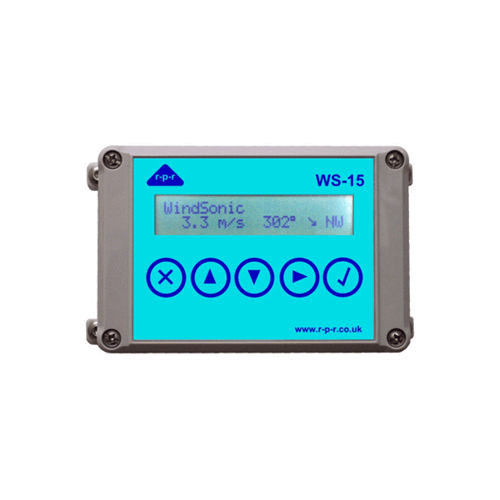
The WS-15A is a cost effective, compact and easy to read 40 character weather display delivering meteorological data including wind speed in a choice of measurement units and wind direction in degrees. A volt free relay (control) output or, a rated +VDC (supply) switched output is controlled by a user defined wind speed threshold alarm, that can be set either as a high or low alarm activating for example an audible alarm unit or a door control switch.
Product Description
WS-15A Weather Display Description
The WS-15A wind and weather display is compatible with a wide range of meteorological sensors including Gill’s WindSonic, MetPak, WindObserver and WindMaster sensors plus LCJ Capteurs CV7 and the Calypso ultrasonic anemometers range and other sensors outputting NMEA wind data.
Data can be viewed on the 40 character display, showing wind speed in a choice of measurement units and wind direction in degrees, as a wind arrow and as cardinal points. Additional weather parameters including temperature, pressure, relative humidity and dew point are displayed when connected to a Gill MetPak sensor and sonic temperature and speed of sound are available with the Gill WindObserver sensor.
The unit is operated using five tactile buttons with displayed prompts making configuration a simple process. Adjustable settings include; sensor alignment, wind speed alarm, wind speed units, pressure calibration, sensor input, display contrast and backlight. The display has an adjustment lock to avoid inadvertent alteration of the wind speed alarm and sensor settings.
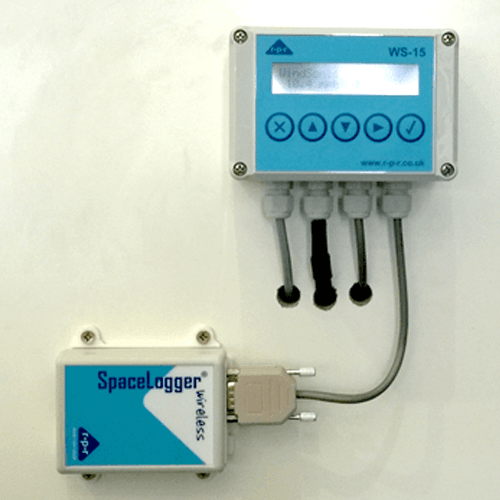
An RS232 output is provided for connecting for example:
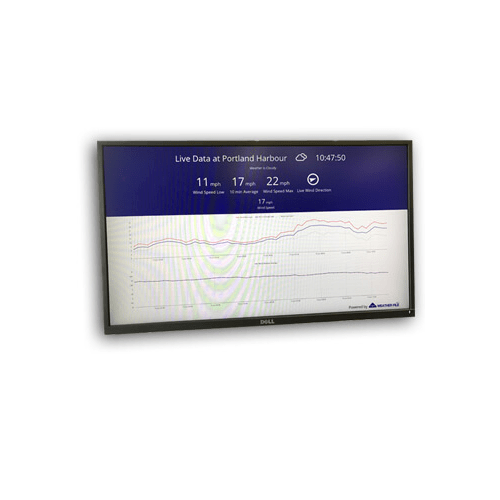
• WeatherFile Communication Unit (WCU); allowing data to be transferred to our cloud solution WeatherFile.com.
• SpaceLogger.W10 wind & weather data logger; for local standalone data logging.
• Computer or radio modem.
A volt free relay (control) output, or, a rated +VDC (supply) switched output is controlled by the WS-15A alarm settings allowing the user to configure a wind speed alarm that can be set as either a high or a low alarm with adjustable hold-off and hold-on times to avoid false alarm events. The output can activate a local audible, visual or dual (audible & visual) alarm or for example a door control switch.
When using the RS422/RS485 input, the display can often eliminate the need for a separate RS422/RS485 to RS232 converter. There is also an optically isolated input for when extra isolation of the sensor is required.
Several WS-15A display units can be connected to one sensor or daisy chained using the RS232 output.
WS-15A display is compatible with:
• Gill WindSonic sensors
• Gill WindObserver sensors
• Gill GMX sensors
• Gill MetPak & MetPak Pro Weather Stations
• LCJ Capteurs CV7-V (T) ultrasonic sensor
• Calypso Wired ultrasonic sensors
• NMEA sensors
Typical Applications
• Meteorological data collection
• Wind farm surveying and operations
• Construction industry including crane operations
• Education and research projects
• Aviation operations
• Data buoys
• Health and safety
• Sports and outdoor activities
• Agriculture & Horticulture
• HVAC
• Transport – roads, bridges & tunnels
• Marine & offshore
• Turbulence
• Waste & recycling
Features
• Digital display of wind speed and direction
• Wind speed in m/s, knots, mph, km/h, or ft/min
• Wind direction arrow with selectable cardinal points
• High or low wind speed alarm with, hold-on and hold-off period to inhibit false alarms
• Volt free relay alarm output
• Easy to operate display with user prompts
• Clear alpha-numeric display, backlight with contrast control
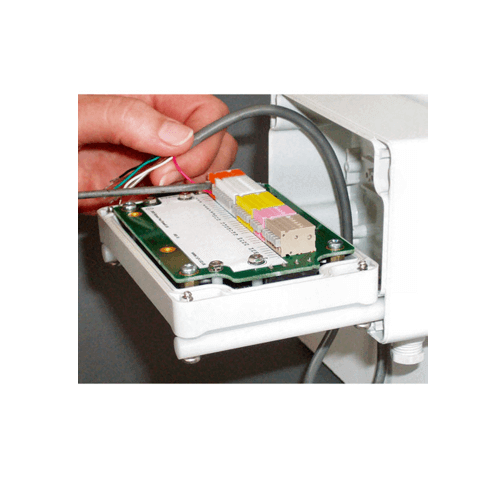
• Simple to install with screwless terminals
• Rugged construction, IP65
• Will display wind direction and wind speed from a wide range of sensors
• Gill WindSonic
• Gill MetPak
• Gill MaxiMet (GMX)
• NMEA 0183 sensors that output the MWV sentence
• Data inputs: RS232, RS422/RS485 or NMEA (optically isolated)
• Will display additional functions from MetPak and WindObserver sensors
• Two RS232 data outputs for connection to datalogger and/or additional WS-15A displays
• Sensor/system status code display for diagnostics
| Physical | Dimensions | Width: 140mm (including mounting feet) Depth: 100mm (including cable glands) Height: 65mm (including mounting feet) |
| Panel Dimensions | 120mm x 80mm | |
| Weight | 0.35 kg | |
| Mounting | Surface mounted | |
| Material | Light Grey ABS Polycarbonate Blend | |
| Cable access | 4 waterproof glands | |
| Power | Power requirements | 9 to 30 Vdc |
| Current at 12 Vdc | 20mA to 35mA (backlight on) | |
| Supply Input protection | Polarity reversal protected. Internal fuse 500mA slo-blo (Littelfuse 0454500 or equivalent) | |
| Connection | Internal lever action terminals for AWG 28 to 22 conductors (0.32 to 0.65mm diameter) | |
| Environmental | Temperature | Operating range: -10°C to +70°C |
| Sealing | IP65 | |
| EMC | EN61326:1977, EN60945:2002 (emissions) EN61326:1997 (immunity) |
|
| Display Operation | Display | Two line 20 character dot matrix super-twist LCD with backlight |
| Operation | 5 keys on front of unit for menu navigation, data entry and control functions | |
| Functions | Wind speed | |
| Wind direction | ||
| Wind speed high/low alarm with hold on and hold off period | ||
| Pressure (when using MetPak II weather station) | ||
| Relative Humidity (when using MetPak II weather station) | ||
| Air Temperature (when using MetPak II weather station) | ||
| Dew point (when using MetPak II weather station) | ||
| Sensor supply voltage (when using MetPak II weather station) | ||
| Sensor alignment adjustment | ||
| Wind speed measurement units selection | ||
| Contrast | ||
| Backlight | ||
| Sensor selection | ||
| Radio signal strength | ||
| Pressure calibration setting (when using MetPak II weather station) | ||
| Speed of Sound (when using WindObserver II sensor) | ||
| Sonic temperature (when using WindObserver II sensor) | ||
| Data output configuration | ||
| Wind direction display | Digital 3 digits with wind arrow and cardinal points | |
| Wind speed display | Digital display with units selection from kts, mph, km/h, fpm, m/s | |
| Sensor status | Error code displayed for sensor/communications diagnostics | |
| Connectivity | Wind sensor | WindSonic sensor outputting RS232 or RS422/485 at 9600 baud in factory default format |
| MetPak II weather station outputting RS232 or RS422/485 at 9600 baud in factory default format | ||
| WindObserver II outputting RS422/485 at 9600 baud in factory default format | ||
| Sensors outputting NMEA 0183 MWV sentence at 4800 baud | ||
| Gill MaxiMet GMX200, GMX240, GMX500, GMX501, GMX541, GMX550, GMX551, GMX600 The sensors should be set their default output with wind direction and wind speed as the first two fields after the sensor identifier (Q). If RS485 is used the baud rate should be set to 9600. | ||
| Alarm output | Volt free relay output. Max 24Vdc at switching current of 0.5 amperes. Contact resistance 0.150 ohm maximum | |
| Data output | RS232 for connection to a WindLogger or other data logger, computer, communications equipment or additional WS-15A display units | |
| Radio Modem | Digi Xstream-PKG radio modem as supplied by RPR Ltd |
The manufacturer reserves the right to amend the specification and therefore the information in this document may be subject to change
| Data Sheets | |
|---|---|
 |
WS-15A Ultrasonic Wind System – Data Sheet |
| User Manual | |
|---|---|
|
WS-15A Display Unit User Handbook – Issue 15 |